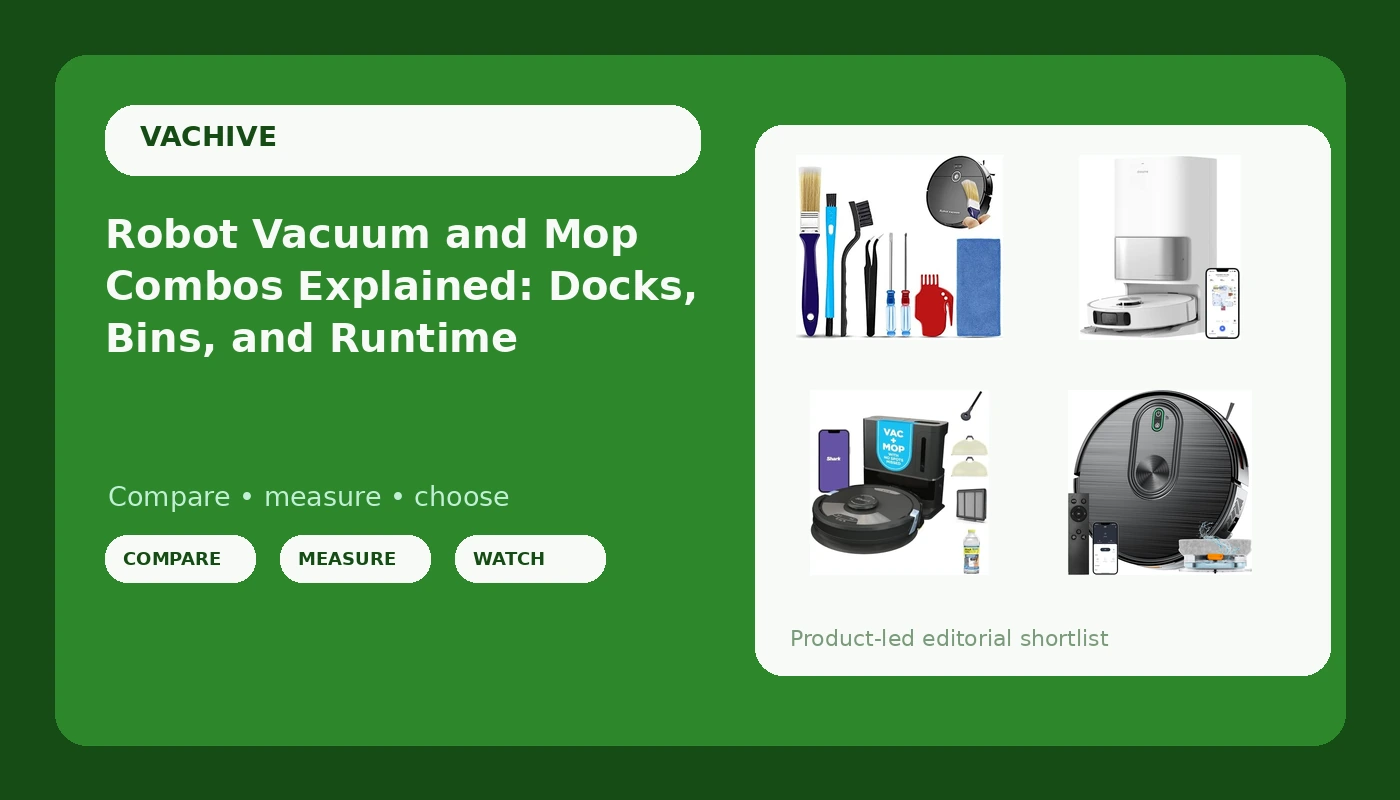
A robot vacuum and mop combo sounds like one purchase that solves two chores, and that is exactly where buyers get tripped up. The vacuum half is fairly judgeable: suction, brush design, and how the robot finds its way around a couch. The mop half is where the marketing turns to fog, because "mop" can mean a damp cloth dragged behind the chassis, a scrubbing pad, or a full dock that washes and dries the pads for you. Those are three different machines wearing the same label. The four products below sit at different points on that spectrum, from a combo with a 200 minute listed runtime and no dock at all, to a system whose base empties its own bin, refills its own water, and cleans its own mops. This explainer goes through what each one actually is, what the listed specs do and do not tell you, and how to pick the kind of setup your floors and your habits can live with.
Related: Robot Vacuum Maintenance: Bins, Brushes, and Filters →
Quick answer
For the most hands-off setup of the four, the dreame L10s Ultra is the one with a base that self-empties, self-refills, and washes and dries its mop pads. For a mainstream 2-in-1 vacuum and mop from a brand with a deep floor care lineup, the Shark Matrix Plus AV2610WA is the straightforward pick. If listed runtime and suction numbers are what you are comparing, the 6500Pa combo carries the longest runtime figure here and the highest listed suction. And whichever robot ends up in your house, the cleaning kit is the unglamorous accessory that keeps brushes, filters, and hair tangles from becoming a weekly argument.
Four useful options
| Model | Best fit | What stands out |
|---|---|---|
| dreame L10s Ultra Robot Vacuum and Mop Combo | Households that want dock automation | Self-emptying and self-refilling base, auto mop washing and drying, 5300Pa listed suction, AI navigation |
| SharkMatrix Plus 2-in-1 Robot Vacuum & Mop, Black/Brass, AV2610WA | Buyers who want a 2-in-1 from a familiar floor care brand | Combined vacuum and mop design in a Black/Brass finish |
| Robot Vacuum and Mop, 6500Pa Suction, 2 in 1 | Long runtime without a dock | 6500Pa listed suction, 200 minute listed runtime, gyro inertial navigation, app, remote, and voice control |
| Robot Vacuum Cleaning Kit, Cleaning Tool with Brush, Cloth, Hair Cutter | Upkeep on any robot | Brush, cloth, and hair cutter in one kit |
The automation option: dreame L10s Ultra Robot Vacuum and Mop Combo, Auto Mop Cleaning and Drying, Self-Refilling and Self-Emptying Base for 60 Days of Cleaning, 5300Pa Suction and AI Navigation, Compatible with Alexa
The trade-off with any dock-based system is footprint and dependence. A base that washes mops needs a spot near a floor drain or at least near a water source you are willing to refill, and it needs clearance on all sides so the robot can dock cleanly. The "60 days" figure is a manufacturer description of bin capacity under normal use, not a guarantee, and homes with shedding pets will fill a bag faster than that. What the dock genuinely changes is the daily friction: instead of emptying a bin and rinsing a pad after every run, you are topping up a tank and swapping a bag on a much slower cycle. That is the difference between a robot that runs daily and a robot that runs when you remember.
The mainstream 2-in-1: SharkMatrix Plus 2-in-1 Robot Vacuum & Mop, Black/Brass, AV2610WA
The reason to consider a brand like this is not a spec sheet, it is the ecosystem. Filters, brushes, and mop pads tend to stay available longer, and when something breaks you are dealing with a company that has a support structure rather than a marketplace seller. The trade-off is that a combo without a washing dock puts the mop maintenance back on you: pads get rinsed, dried, and eventually replaced by hand. That is fine if you mop occasionally. It gets old fast if you run the thing every day on a kitchen floor.
The long-runtime value angle: Robot Vacuum and Mop, 6500Pa Suction, 2 in 1 Robotic Vacuum with Gyro Inertial Navigation, 200 Min Runtime, App/Remote/Voice Control, Ideal for Pet Hair, Hard Floor, Carpet
The honest read on gyro inertial navigation is that it keeps the robot on a reasonably systematic path using motion sensing, but it does not build the same kind of camera or lidar map that AI navigation systems do. In practice that means fewer no-go zones, less room-by-room control, and a robot that may re-cover ground it already cleaned. The trade-off in the other direction is price and simplicity: there is no dock to site, no bag to buy, and no water line to think about. You empty the bin yourself, which takes under a minute, and you rinse the mop pad yourself. For a single-floor home where you want long runs without a base station, that is a defensible bargain.
The upkeep accessory: Robot Vacuum Cleaning Kit, Cleaning Tool with Brush, Cloth, Hair Cutter
It is easy to treat maintenance tools as filler, and it is also why so many robots end up parked in a closet by month three. A brush roll caked in hair stops picking up, a clogged filter cuts suction, and a dirty charging contact turns into a robot that "randomly" dies mid-run. None of those are failures of the robot, they are failures of upkeep, and a hair cutter plus a stiff brush handles most of it in a few minutes a week. Buy this with the robot, not after the first problem.
Prices and availability may change. Product images, names, and retailer links must be matched by verified ASIN. Do not state a current price, rating, stock status, or measured result without current evidence.
What self-emptying and self-cleaning actually mean
These two words get used interchangeably and they are not the same thing. Self-emptying refers to the dock pulling debris out of the robot's dustbin and into a sealed bag or canister on the base. That is the feature that turns a daily chore into a roughly monthly one, and it matters most in homes with pets, where a bin can fill in a single run. Self-cleaning usually refers to the mop side: the base sprays the pads, scrubs them against a ribbed tray, and then dries them, often with warm air. Drying is the underrated half, because a pad left damp in a dark dock grows a smell you will notice the next time the robot runs.
Self-refilling is a third feature and it belongs to the base, not the robot. A dock with a clean water reservoir tops up the robot's onboard tank so you are not carrying a jug to the machine every time. The cost of all three features is the base itself: it takes up floor space, it needs a power outlet and clearance, and it introduces consumables like dust bags and replacement pads. A self-emptying base is also not a self-cleaning base. You still wipe the dock tray, you still check the bag, and you still clear hair from the brush roll. What you stop doing is the every-run routine.
There is also a naming trap worth knowing. "2-in-1" describes a robot that vacuums and mops, not a robot that does both simultaneously. Many combos vacuum first and then switch to a mopping pass, which is why a single run can take longer than expected on a large floor. If the listing does not spell out the sequence, assume you will be setting modes rather than getting both jobs in one pass.
How to read suction and navigation specs
Suction is listed in pascals, and the numbers here range from 5300Pa to 6500Pa. Pascal ratings describe the pressure the motor can generate, but real pickup depends on more than that: the seal between the robot and the floor, the airflow path, the brush design, and how many passes the robot makes over the same spot. A higher listed figure is a reasonable tiebreaker, not a prediction. Two robots with the same rating can leave very different dustbins after a week, which is why the bin, not the box, is the honest scoreboard.
Navigation is the spec that changes how the robot feels day to day. Gyro inertial navigation uses motion and rotation sensing to estimate position. It produces systematic coverage patterns without the cost of cameras or lidar, but it cannot recognize a charging cable as an obstacle or remember that you asked it to skip the bathroom. AI navigation uses cameras and sensors to build a map, identify obstacles, and let you define no-go zones. It is more capable and more expensive, and it still is not a substitute for picking up the floor.
Five steps to decide, in order:
- Count your floor transitions. Rugs, thresholds, and room lips are where robots fail, so note how many raised edges sit between rooms.
- Decide whether you want damp mopping or real scrubbing. A combo that drags a damp pad is for maintenance, not for a sticky kitchen floor.
- Be honest about emptying. If you will not empty a bin every day or two, buy the self-emptying base.
- Match runtime to your largest single floor. A 200 minute listed runtime covers a big open plan; a smaller figure may need a mid-run recharge.
- Budget for consumables. Bags, filters, pads, brush rolls, and a cleaning kit are part of the cost of ownership.
Practical guidance for a combo in a real home
- Run the robot in vacuum mode for the first week before you turn on mopping, so you learn where it gets stuck without smearing dust around.
- Pick up cords, socks, and pet waste before the first several runs. Obstacle avoidance helps, it does not excuse a messy floor.
- Empty the bin and rinse or replace the mop pad after runs on kitchen floors, because food residue is what starts odors in a dock.
- Cut wrapped hair off the brush roll weekly with a hair cutter, and tap the filter out with a brush rather than washing it unless the manual says so.
- Give the dock a level hard surface with clearance on both sides, and keep it off carpet if the base washes mops.
Which option should you choose?
Choose the dreame L10s Ultra when you want the dock to carry the maintenance load, with self-emptying, self-refilling, and mop washing and drying handled at the base. Choose the SharkMatrix Plus 2-in-1 Robot Vacuum & Mop, Black/Brass, AV2610WA when you want a combined vacuum and mop from a brand with an established floor care lineup and you do not need a washing dock. Choose the Robot Vacuum and Mop, 6500Pa Suction, 2 in 1 when the listed runtime and suction figures are your priorities and you are content to empty a bin and rinse a pad yourself. Choose the Robot Vacuum Cleaning Kit, Cleaning Tool with Brush, Cloth, Hair Cutter whichever robot you buy, because upkeep is what keeps any of them working.
One caveat on all of the above: the specifications discussed here come from the product listings, not from independent measurement. Suction figures, runtime figures, and the 60 day base capacity description are manufacturer claims, and they will vary with floor type, mode, and how much debris your home generates. Confirm the current details, included accessories, and consumable requirements on the listing before you buy.
The bottom line
A robot vacuum and mop combo is really a decision about how much maintenance you want to do by hand. The dreame L10s Ultra pushes that work onto a base station. The Shark Matrix Plus keeps it in a familiar 2-in-1 package. The 6500Pa combo trades dock automation for the longest listed runtime and the highest listed suction in this group. And the cleaning kit covers the part no dock eliminates: hair, dust, and sensors. Pick the robot whose maintenance rhythm matches your week, add the tools to keep it running, and the machine will earn its floor space.