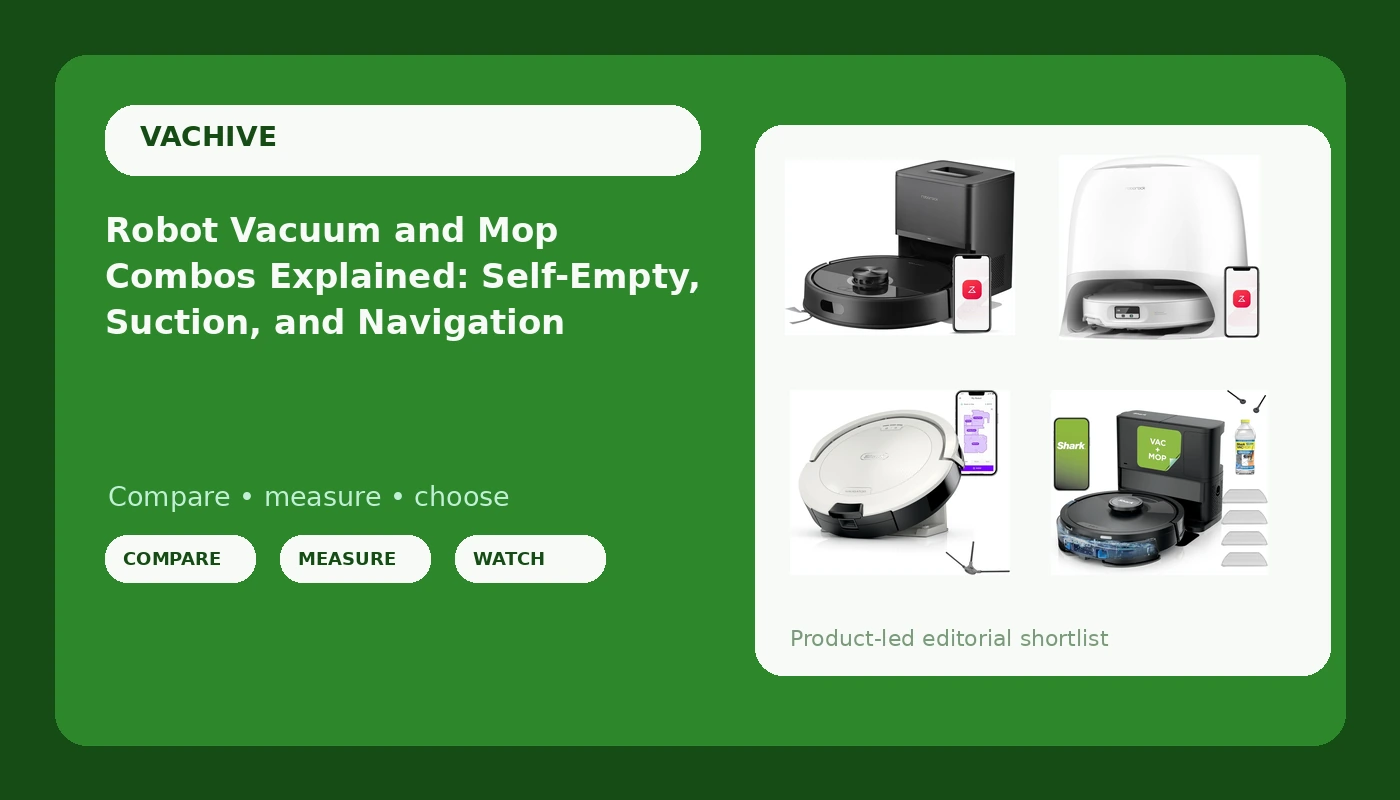
Most people who start shopping for a robot vacuum and mop are not trying to fire their cleaning person. They are trying to stop sweeping the kitchen every single night. After nine years of professional cleaning and five years running a small crew that covers more than 40 homes a week, I have watched the same pattern repeat: the robot that survives in a household is the one whose maintenance matches the household's habits, not the one with the biggest number on the box.
The four models in this guide split along exactly that line. One is designed to go weeks between bin changes. One is built around raw suction. One skips mopping entirely. One sits in the middle. What follows is an explanation of what each design decision costs you in daily upkeep, so you can match the machine to your floors instead of matching it to a spec sheet.
Related: How Self-Emptying Robot Vacuums Actually Work →
Quick answer
The roborock Q7 M5+ is the only model in this group that pairs a self-emptying dock, with a manufacturer-stated interval of up to 7 to 9 weeks between bin changes, with a 10,000Pa suction rating, which makes it the natural starting point if you want the least daily handling. The roborock Qrevo CurvX carries the highest stated suction here at 22,000Pa. The Shark Navigator AV2120 is the vacuum-only option with SmartPath navigation, and the Shark Matrix Plus UR2650WS adds mopping on a Shark platform. None of them removes the need to maintain the machine.
Four useful options
| Model | Best fit | What stands out |
|---|---|---|
| roborock Q7 M5+ Robot Vacuum and Mop, Up to 7-9 Weeks Self-Empty, 10000Pa | Households that want fewer bin trips | Stated self-empty interval of up to 7 to 9 weeks, plus a 10,000Pa suction rating |
| roborock Qrevo CurvX Robot Vacuum and Mop, 22,000Pa Suction | Large floors and heavy debris | 22,000Pa suction rating, the highest figure in this group |
| Shark Navigator Robot Vacuum, SmartPath Navigation, White, AV2120 | Rugs and carpet, no mopping wanted | SmartPath navigation in a vacuum-only design |
| Shark Matrix Plus Robot Vacuum and Mop, UR2650WS | Mixed hard floor and low-pile carpet | Vacuum and mop functions in a single unit |
The self-emptying pick: roborock Q7 M5+ Robot Vacuum and Mop, Up to 7-9 Weeks Self-Empty, 10000Pa
Self-emptying is the feature that decides whether a robot vacuum becomes a habit or a chore. When the bin has to be pulled and dumped after every run, most households skip days, and skipped days are how a robot ends up parked in a closet. A dock that transfers debris into a sealed bag changes the maintenance rhythm from daily to roughly monthly, which is the difference between a tool you use and a tool you own.
Two caveats are worth stating plainly. First, the 7 to 9 week figure is the manufacturer's stated interval, and real-world intervals shrink with floor area, pet hair, and how often you run the machine. Second, self-emptying docks use bags and need their own occasional cleaning. The upside is that the daily job disappears; the trade-off is that you now maintain a dock instead of a bin. For a home with pets or a large floor plan, that trade is usually worth making.
The high-suction pick: roborock Qrevo CurvX Robot Vacuum and Mop, 22,000Pa Suction
Suction ratings are the easiest number to compare and the hardest number to interpret. A 22,000Pa rating describes the vacuum's ability to pull air at the inlet, and more of it helps on carpet, on embedded pet hair, and on debris that a weaker unit would pass over twice. It does not describe airflow across the full cleaning path, brush design, edge reach, or whether the debris that gets picked up actually stays in the bin.
So treat the Qrevo CurvX as the pick for floors that fight back: dense carpet, a shedding dog, tracked-in grit by a back door. If your home is mostly bare hard floor with light dust, the extra suction is money spent on a problem you do not have. Note also that the record for this model lists suction, not a self-empty interval, so if bin handling matters to you, confirm that detail on the current listing before you commit.
The vacuum-only pick: Shark Navigator Robot Vacuum, SmartPath Navigation, White, AV2120
Not every home needs a mop. In carpeted houses, a mopping pad is dead weight that you still have to rinse, dry, and reattach. The Navigator AV2120 skips that hardware entirely and focuses on vacuuming with SmartPath navigation, which is the more honest purchase for a house full of rugs and a kitchen that gets mopped by hand once a week anyway.
The thing to test in your own head before buying is navigation behavior. Every brand names its navigation system differently, and the name matters far less than whether the robot holds a consistent path or rediscovers the room on every run. A robot that wanders is a robot that misses the same corner for a month. This is the trade-off with a vacuum-only unit: you give up mopping convenience, and in exchange you get a simpler machine with fewer parts to clean.
The mop combo pick: Shark Matrix Plus Robot Vacuum and Mop, UR2650WS
Mopping combos earn their keep on sealed hard floors: tile, vinyl, laminate, and finished concrete. They do not replace a real mop on sticky kitchen residue, and on any unit the pad needs to be removed, rinsed, and dried or it becomes a smell problem. The Matrix Plus UR2650WS is the sensible middle of this group: it covers both jobs in one machine without the price of the highest-suction option, and it keeps you inside one brand's app and consumables.
The honest limitation of every robot mop is contact pressure. A robot drags a damp pad across the floor. That lifts dust and light film. It does not scrub. If you have ever wiped a floor with a wet rag and no pressure, you already know what the result looks like, which is why I tell clients to think of robot mopping as maintenance, not as cleaning.
Prices and availability may change. Product images, names, and retailer links must be matched by verified ASIN. Do not state a current price, rating, stock status, or measured result without current evidence.
What a suction rating actually measures
Suction is measured in pascals, and the number you see is taken at the machine's inlet under controlled conditions. That makes it useful for comparing two robots in the same test setup, and misleading when you compare it to what happens on your living room carpet. Airflow, brush agitation, the seal between the robot and the floor, and the path the debris takes into the bin all shape the result.
The practical version of this is what I call the mess index: what is actually in the bin after a scheduled run. A robot with a modest rating that runs daily and reaches the edges will outperform a high-suction unit that skips the baseboards and parks itself under the couch. Suction gets debris off the carpet. Coverage gets it out of the room. You want both, and if you can only guarantee one, guarantee coverage.
Self-emptying, mopping, and navigation: what changes day to day
Self-emptying docks move debris from the robot's bin into a bag in the base. That is the entire trick, and it is a good one. The routine shifts from emptying a bin after every run to swapping a bag every few weeks, and the bin seals better because you touch it less. The costs are the bags, the dock's footprint, and the occasional clog when something long and stringy gets pulled through.
Mopping on a combination unit is a damp pad, sometimes rotating, sometimes vibrating, always light on pressure. It handles dust film and dried footprints. It struggles with anything sticky. Navigation is the third variable: mapping robots build a floor plan and follow it, while simpler systems react to obstacles as they meet them. A stable map means consistent coverage and reliable no-go zones. An unstable one means you re-draw your boundaries after every firmware update, which is the fastest way to stop using the app at all.
- Measure the rooms you want covered and count the floor transitions, including rugs with a lip and thresholds between rooms.
- Decide honestly whether you will empty a bin every day. If the answer is no, prioritize self-emptying.
- Decide whether you need mopping at all, or whether a vacuum-only unit fits your flooring.
- Match the suction rating to your debris: light dust on hard floor needs far less than pet hair embedded in carpet.
- Set the maintenance routine before you buy: bags, filters, brushes, pads, and dock cleaning all have a schedule.
How to pick without overbuying
- Count your rugs first. A robot that cannot climb a rug edge will leave you with a strip of carpet it never touches, no matter what the suction rating says.
- Weigh the bin against the floor plan. Large homes and shedding pets fill bins faster than the marketing interval suggests.
- Treat mopping as a bonus, not the reason to buy. If mopping is your main goal, a dedicated mop or a manual pass will beat any combo.
- Budget for consumables. Bags, filters, and brush rolls are a recurring cost that does not show up in the purchase decision.
- Plan for the app. A schedule you can set once and trust is worth more than a feature list you will never open.
Which option should you choose?
Choose the roborock Q7 M5+ when you want the fewest interruptions and self-emptying matters more than peak suction. Choose the roborock Qrevo CurvX when your floors are carpet-heavy or your household generates serious debris and you want the highest stated suction in this group. Choose the Shark Navigator AV2120 when your home is carpeted, you do not want mop hardware, and you prefer a simpler machine. Choose the Shark Matrix Plus UR2650WS when you have sealed hard floors and want vacuuming and mopping handled by one unit.
A caveat on all four: the specifications quoted here come from the product listings, not from a controlled comparison, and stated intervals and ratings are manufacturer figures. Self-empty intervals depend on debris volume, and suction ratings depend on test conditions. Before buying, confirm the details that matter to you, including dock capacity, mop hardware, and navigation behavior, on the current product page.
The bottom line
The right robot vacuum and mop is the one whose upkeep you will actually perform. If emptying a bin by hand is the step that kills your routine, the self-emptying roborock Q7 M5+ addresses that directly. If your carpets are the problem, the roborock Qrevo CurvX puts the emphasis on suction. If you never wanted mopping in the first place, the Shark Navigator AV2120 keeps the machine simple, and if you have hard floors throughout, the Shark Matrix Plus UR2650WS covers both jobs in one pass. Pick the maintenance rhythm you can live with, then pick the machine that matches it.