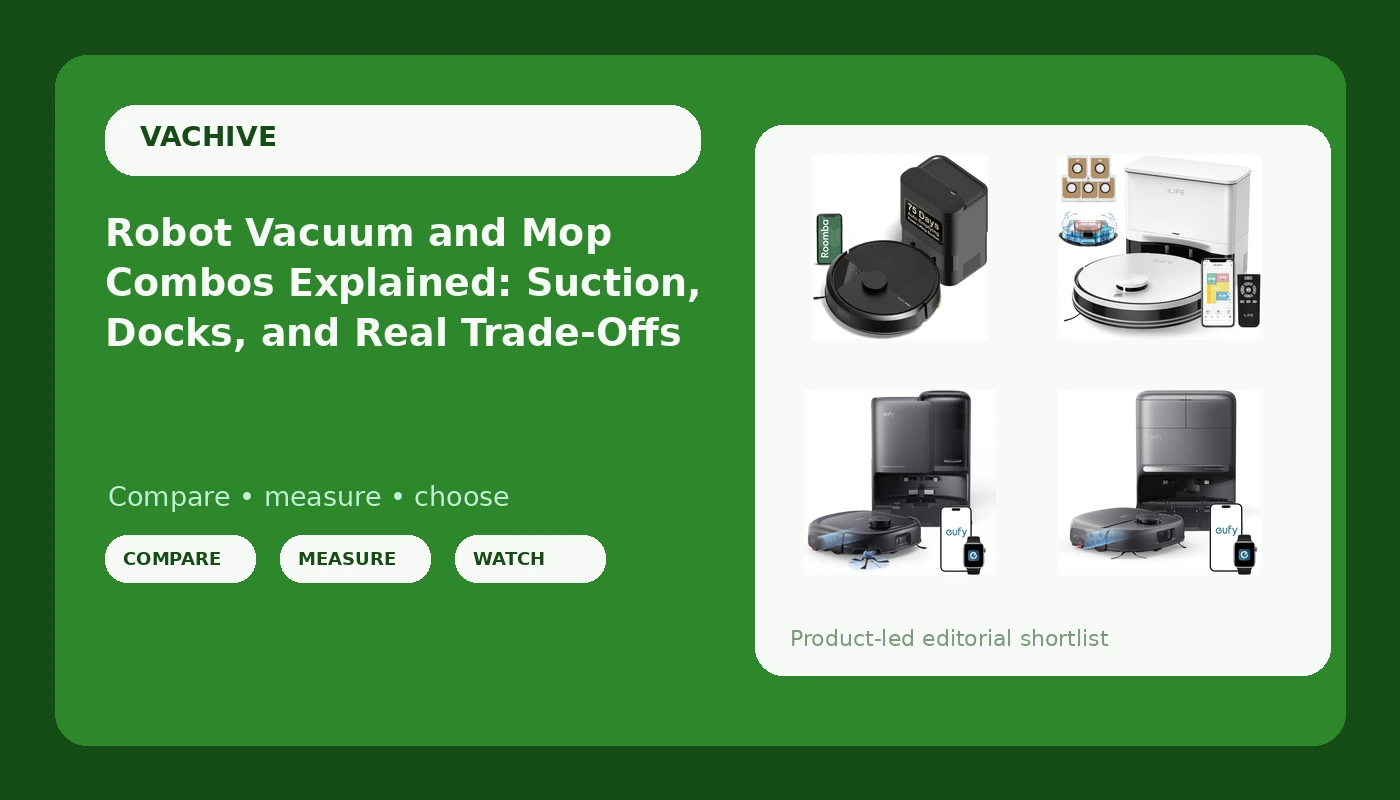
A robot vacuum and mop combo is sold on a single promise: one dock, two chores, less thinking. The spec sheet backs that up with big numbers, and that is exactly where buyers get into trouble. Suction is quoted in pascals measured at the inlet, mop systems are described in language that makes them sound interchangeable, and self-emptying docks are marketed with a day count that assumes a very specific kind of dirt.
The practical question is not which machine has the largest number printed on it. It is which combination of vacuum, mop, and dock matches your floors, your mess, and the amount of maintenance you are honestly willing to do every week. What follows is a walk through four current options, what their specs mean in a real house, and which one fits which situation.
Related: Self-Emptying Robot Vacuum Docks: What 75 Days Actually Means →
Quick answer
For a home that wants hands-off emptying and does not need a mop, the iRobot Roomba 105 Vac with AutoEmpty Dock is the straightforward choice, because the dock is rated to hold debris for up to 75 days and the vacuum is built for multi-surface cleaning with LiDAR navigation. If mopping matters, the two eufy combos use HydroJet roller mops, with the eufy E25 rated at 20,000 Pa and the eufy C28 at 15,000 Pa, while the ILIFE A30 Pro covers vacuum and mop with a 10,000 Pa maximum suction rating for lighter cleaning. None of these is the right answer for every floor plan; the fit depends on your floor mix and how often you will actually run the thing.
Four useful options
| Model | Best fit | What stands out |
|---|---|---|
| iRobot Roomba 105 Vac with AutoEmpty Dock | Homes that want self-emptying vacuuming without a mop | AutoEmpty dock rated for up to 75 days between empties, LiDAR navigation, multi-surface cleaning, systematic row pattern |
| ILIFE A30 Pro | Apartments and lighter cleaning on a tighter budget | Vacuum and mop in one unit with a 10,000 Pa maximum suction rating |
| eufy E25 | Large hard-floor homes with heavy mopping needs | 20,000 Pa suction rating plus a HydroJet roller mop |
| eufy C28 | Hard-floor homes that want roller mopping at a lower spec | 15,000 Pa suction rating plus a HydroJet roller mop |
The dock-first pick: iRobot Roomba 105 Vac with AutoEmpty Dock
The trade-off here is obvious once you name it: there is no mop. For carpet-heavy homes and anyone who already owns a mop or a steam cleaner, that is not a loss. It also means one less consumable to think about, since a roller or pad is not sitting damp in a dock between runs. What you do take on is dock bags, which are a recurring purchase, and a dock footprint that needs floor space and a nearby outlet. The 75-day figure is a manufacturer rating based on typical debris loads; a shedding dog or a house with three cats will shorten it, and the bin sensor will tell you when.
The value pick: ILIFE A30 Pro
The thing to check before buying any combo at this level is what kind of mop it actually uses. A pad that drags a damp cloth behind the robot behaves very differently from a powered roller, and the listing photos and description are the place to confirm which one you are getting. If your home is mostly hard floor with light dust and occasional kitchen spills, the lower suction rating is not the limiting factor. If you have thick carpet, area rugs with fringe, or a heavy shedder, the gap between 10,000 Pa and the eufy ratings is the number you will feel.
The high-power mop combo: eufy E25
Roller mop systems work differently from flat pads. A roller turns against the floor and is rinsed as it goes, which keeps it from dragging the same dirty cloth across the whole kitchen. That matters most in homes with hard floors throughout, where a mop pad tends to redistribute a thin film rather than lift it. The cost of that design is maintenance you still own: rollers and their housing need cleaning on a schedule, and a dock that handles water adds footprint and refill chores. High suction ratings also do not guarantee better pickup on every surface, because airflow, brush design, and how well the bin seals all matter.
The step-down mop combo: eufy C28
The honest question with the C28 is whether the difference between 15,000 Pa and 20,000 Pa shows up in your house. On sealed hard floors with everyday dust, both ratings are far above what it takes to lift loose debris, and the mop system is doing more of the work than the vacuum. On medium-pile carpet, embedded grit, and pet hair, more suction and more airflow help. Since these two share the same mop technology, the decision comes down to floor mix and how much you want to spend, not to a feature you would be giving up.
Prices and availability may change. Product images, names, and retailer links must be matched by verified ASIN. Do not state a current price, rating, stock status, or measured result without current evidence.
What suction ratings do and do not tell you
Pascal ratings describe suction pressure, typically measured in a controlled setup at the machine's inlet. They do not describe airflow, brush agitation, how well the dustbin seals, how much debris actually reaches the bin, or how the robot behaves on a half-inch rug lip. Two machines with the same number can clean very differently, which is why the rating is a starting filter rather than a verdict.
The more useful mental model is to treat the dustbin as the scoreboard. After a week of scheduled runs, what is in the bin tells you whether the robot is picking up real dust and grit or just fluff and surface lint. That check costs nothing and it applies to every model here. It also exposes the failure mode people miss: a robot that navigates beautifully but leaves a strip along every baseboard. Edge cleaning is a separate capability from suction, and no pascal figure describes it.
If you are comparing the 10,000 Pa ILIFE against the 20,000 Pa eufy E25, understand what you are buying with the difference. You are buying margin for carpet, for embedded debris, and for the days you skip a run and the floor gets worse. You are not buying a proportional improvement in visible cleanliness on bare tile.
Roller mops, pads, and where the dock fits
Mop systems fall into two broad families. Pad mops drag a damp cloth, which is fine for light dust and a disaster on sticky spills because the pad saturates and then smears. Roller mops use a rotating, rinsed roller, which agitates the floor and keeps relatively clean material against it. The HydroJet roller design on the E25 and C28 belongs to the second family; the ILIFE listing should be checked for which approach it uses, since the two behave nothing alike.
Water handling is the other half of the story. A combo machine needs a clean water tank, a dirty water tank, and a place for both to live. If the dock manages that, you get fewer hands-on steps but a larger dock and a new set of refill habits. If it does not, you are filling and emptying reservoirs by hand, which is still less work than mopping but nowhere near hands-off.
Self-emptying is a separate system from mopping, and the Roomba 105's dock is the clearest example here. A sealed bag holds debris so you are not touching the bin every day. The 75-day rating assumes a typical debris load. Pets, long hair, and construction dust shorten it fast, and bags are a consumable you will rebuy.
A five-step way to decide:
- Measure your floor mix. Count rooms by hard floor versus carpet, not by square footage.
- Check your transitions. Walk the house and note every rug lip, threshold, and doorway saddle. Robots struggle with these more than spec sheets admit.
- Decide whether you want a mop at all. If you already mop weekly and do not mind it, paying for a combo buys you convenience, not capability.
- Decide whether self-emptying matters. With pets, allergies, or a daily run habit, it changes how often you touch the machine.
- Price the consumables. Bags, filters, pads or rollers, and cleaning solution add up over a year and are easy to overlook.
Practical guidance before you buy
- Run the robot daily if you want the floor to stay at a maintenance level. A weekly run means you are still doing the real cleaning.
- Clear charging cords and small objects before the first few runs, then watch where it gets stuck. Cord tangles are the most common cause of a robot dying mid-job.
- Verify no-go zones and room boundaries after any firmware update. Mapping data can reset, and re-drawing zones gets old quickly.
- Keep the dock on a hard, level surface with clearance on both sides. Carpet under a dock can interfere with docking and with water systems.
- Clean the brush roll, filter, and any mop roller on the schedule in the manual. Most performance complaints trace back to a clogged filter or a matted brush.
Which option should you choose?
Choose the iRobot Roomba 105 Vac with AutoEmpty Dock when you want vacuuming to run itself, your floors are carpet or a mix, and you are fine handling mopping separately. Choose the ILIFE A30 Pro when you want a single unit that vacuums and mops, your floors are mostly hard surface, and the 10,000 Pa rating matches the mess you actually have. Choose the eufy E25 when you have significant carpet or heavy debris and want the highest suction rating in this group along with a roller mop. Choose the eufy C28 when you want the same roller mop approach but the 15,000 Pa rating is enough for your floors.
The limitation worth stating plainly: everything above comes from manufacturer specifications and product descriptions, not from independent measurement. Suction ratings are not standardized across brands, and dock day-counts depend on how much dirt your home generates. Confirm bin capacity, what is included in the box, and the exact mop design on the current listing before you commit.
The bottom line
Four machines, three different jobs. The Roomba 105 is a vacuum-first tool whose value is the dock, not the mop. The ILIFE A30 Pro gets you into combo territory at the lowest suction rating of the group. The eufy E25 and C28 share a roller mop system and differ mainly in suction, at 20,000 Pa and 15,000 Pa respectively. Match the machine to your floor mix, check the consumables, and plan on running it more often than you think. A robot vacuum is a maintenance tool, and the dustbin after a week is the only review that counts.